
Scientific Method – What is it?
🔬 Step-by-step investigation
A process used to ask questions, test ideas, and find answers.
Steps often include question → hypothesis → experiment → analyze → conclude.
⚠ Common Mistake: Thinking the steps must always be in the same order.
⏱ In 10 seconds: What step usually comes after forming a question?
Hypothesis – What is it?
🧠 Testable prediction
A hypothesis is an educated guess you can test.
Example: “Plants grow faster with more sunlight.”
⚠ Common Mistake: Confusing hypothesis with opinion.
⏱ In 10 seconds: Is your hypothesis testable?
Independent Variable – What do you change?
🔧 The cause
It’s the factor you change on purpose in an experiment.
Example: amount of sunlight
⚠ Common Mistake: Mixing it with the outcome.
⏱ In 10 seconds: What did the scientist change?
Dependent Variable – What do you measure?
📏 The effect
It’s what you observe or measure as a result.
Example: plant height
⚠ Common Mistake: Thinking it’s the thing you control.
⏱ In 10 seconds: What depends on the independent variable?
Controls – What stays the same?
⚖ Everything except the variable
Factors kept constant so the test is fair.
Example: same soil, same pot, same water amount.
⚠ Common Mistake: Ignoring uncontrolled factors.
⏱ In 10 seconds: Name one thing you must keep the same.
Control Group – Why is it needed?
🎯 For comparison
It’s the group that does not get the change, used to compare results.
Example: Plants with normal sunlight.
⚠ Common Mistake: Thinking all groups must be changed.
⏱ In 10 seconds: What does the control group show?
Experimental Group – What happens here?
🔧 Gets the treatment
The group that receives the change being tested.
Example: Plants with extra sunlight.
⚠ Common Mistake: Mixing it with the control group.
⏱ In 10 seconds: What change does this group get?
Sample Size – Why does it matter?
🔢 More samples = better data
Larger groups give more reliable results.
Example: Testing 30 plants is better than 3 plants.
⚠ Common Mistake: Drawing conclusions from tiny samples.
⏱ In 10 seconds: Why is a bigger sample better?
Trials – Why repeat an experiment?
🔁 More reliability
Repeating experiments reduces the chance of errors or luck.
Example: Testing a reaction 5 times.
⚠ Common Mistake: Using only one test.
⏱ In 10 seconds: What happens if results differ a lot?
Data Table – What does it organize?
📊 Numbers in rows and columns
A table organizes data clearly so you can compare values easily.
Example: time vs plant height.
⚠ Common Mistake: Misreading rows and columns.
⏱ In 10 seconds: What two categories are being compared?
Bar Graph – What does it show?
📉 Compare categories
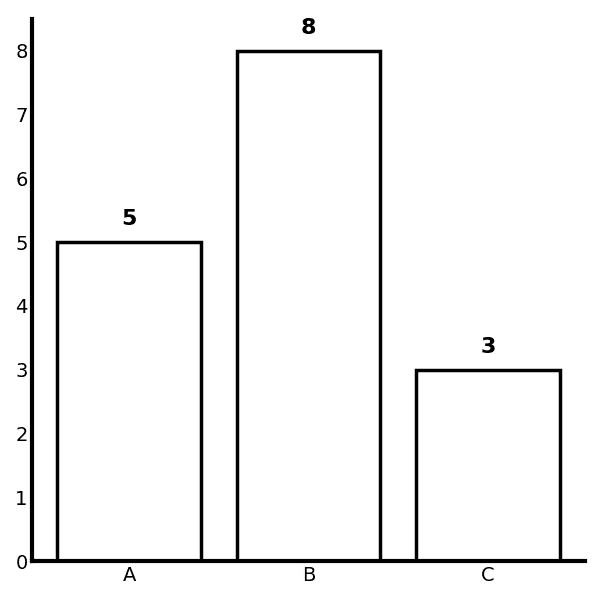
Bar graphs compare amounts across different groups.
Example: fruit sales by type.
⚠ Common Mistake: Ignoring the scale on the axis.
⏱ In 10 seconds: Which bar is tallest?
Line Graph – What trend does it show?
📈 Change over time
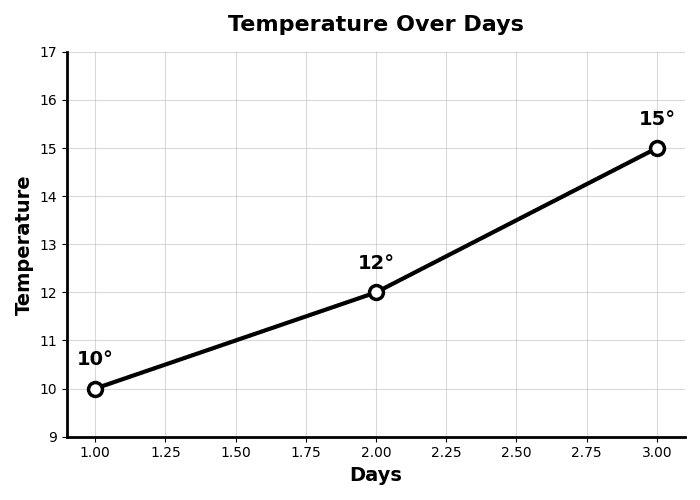
Line graphs show how something changes over time.
Example: temperature each hour.
⚠ Common Mistake: Reading the line as exact between points.
⏱ In 10 seconds: Is it increasing or decreasing?
Pie Chart – What is the whole circle?
🍰 100% of the data
Pie charts show parts of a whole as percentages.
Example: 25% = one-fourth of the circle.
⚠ Common Mistake: Comparing slices without looking at labels.
⏱ In 10 seconds: What percent is the whole pie?
Scatter Plot – What do the dots show?
📍 Two-variable data
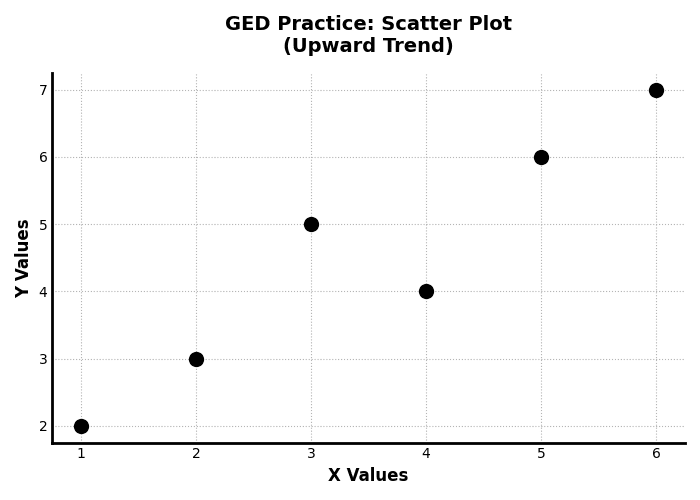
Each dot shows a pair of related values.
Example: hours studied vs score.
⚠ Common Mistake: Expecting a perfect line.
⏱ In 10 seconds: Is there a pattern?
Correlation – How do variables move?
⬆⬆ / ⬆⬇ / no pattern
Positive: both rise.
Negative: one rises, the other falls.
None: no pattern.
Example: hours studied & score → positive.
⚠ Common Mistake: Thinking correlation = cause.
⏱ In 10 seconds: Which correlation is shown?
Trend – What direction is the data going?
➡ up, down, flat
A trend is the general direction of data points.
Example: sales rising over months.
⚠ Common Mistake: Focusing on one point instead of the pattern.
⏱ In 10 seconds: Is the line mostly going up or down?
Outlier – What makes a point unusual?
🚨 Far from the others
An outlier is a value far outside the normal pattern.
Example: 5, 6, 7, 40 → 40 is outlier.
⚠ Common Mistake: Ignoring outliers without checking why.
⏱ In 10 seconds: Which number doesn’t fit?
Cause & Effect – What does the experiment test?
🔗 If → then
Cause = what you change. Effect = what changes because of it.
Example: more sunlight → taller plants.
⚠ Common Mistake: Confusing correlation with cause.
⏱ In 10 seconds: What was the cause?
Claim – What is the scientist saying?
📢 A statement based on evidence
A scientific claim is a statement supported by data.
Example: “Plants grow faster with extra light.”
⚠ Common Mistake: Giving opinions instead of evidence.
⏱ In 10 seconds: What evidence supports the claim?
Evidence – What counts?
📊 Numbers, observations, results
Good scientific evidence comes from measurements, data, or observations.
Example: “Plants with extra light grew 5 cm more.”
⚠ Common Mistake: Using feelings or beliefs as evidence.
⏱ In 10 seconds: Is this evidence measurable?
Cell – What is it?
🧬 Basic unit of life
A cell is the smallest unit that can perform all life functions.
Example: skin cells, blood cells.
⚠ Common Mistake: Thinking cells are only in animals.
⏱ In 10 seconds: What is the job of a cell?
Nucleus – What does it store?
📚 DNA and instructions
The nucleus controls the cell and stores DNA.
Example: The “control center.”
⚠ Common Mistake: Confusing nucleus with mitochondria.
⏱ In 10 seconds: What important molecule is here?
Mitochondria – What do they produce?
⚡ Energy (ATP)
Mitochondria turn food into energy the cell can use.
Example: the “powerhouse.”
⚠ Common Mistake: Thinking mitochondria store DNA.
⏱ In 10 seconds: What kind of energy do they produce?
Cell Membrane – What does it control?
🚪 In & Out
The membrane controls what enters and exits the cell.
Example: letting nutrients in, waste out.
⚠ Common Mistake: Thinking it’s only protection.
⏱ In 10 seconds: What does the membrane allow?
Chloroplast – What is made here?
🌞 Food from sunlight
Chloroplasts use sunlight to make food (photosynthesis).
Example: green leaves.
⚠ Common Mistake: Thinking animals have chloroplasts.
⏱ In 10 seconds: What process happens here?
Photosynthesis – What’s the formula idea?
☀ Light → Food + Oxygen
Plants use sunlight, water, and CO₂ to make sugar and oxygen.
Example: trees creating oxygen.
⚠ Common Mistake: Thinking plants “eat soil.”
⏱ In 10 seconds: What gas do plants release?
Respiration – What does it release?
⚡ Energy from food
Cells break down sugar with oxygen to release energy.
Example: your muscles using energy.
⚠ Common Mistake: Confusing with breathing (lungs).
⏱ In 10 seconds: What two things does respiration need?
DNA – What does it carry?
🧬 Genetic information
DNA carries your traits and instructions for the body.
Example: eye color.
⚠ Common Mistake: Thinking all traits are from one gene.
⏱ In 10 seconds: Where is DNA stored?
Gene – What is it?
📌 A piece of DNA with one trait
A gene is a small piece of DNA that controls one trait.
Example: hair color.
⚠ Common Mistake: Thinking genes change easily.
⏱ In 10 seconds: What trait can a gene control?
Chromosomes – What do they hold?
🧵 Long DNA strands
Chromosomes are long strands of DNA with many genes.
Example: humans have forty-six.
⚠ Common Mistake: Confusing chromosomes with cells.
⏱ In 10 seconds: What are chromosomes made of?
Dominant or Recessive – Who shows up?
👁 The stronger gene shows
Dominant traits show if at least one copy is present;
Recessive traits show only if two copies are present.
Example: brown eyes (dominant).
⚠ Common Mistake: Thinking recessive = “weaker.”
⏱ In 10 seconds: What trait shows with one dominant allele?
Punnett Square – What does it predict?
📦 Trait probability
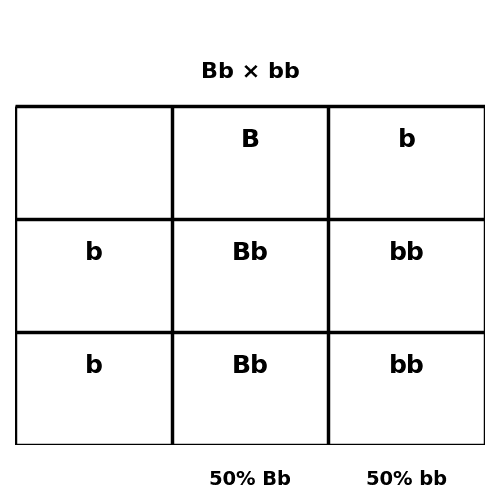
It shows the chances of offspring inheriting traits.
Example: Bb × Bb → seventy-five percent chance of brown eyes.
⚠ Common Mistake: Thinking results are guaranteed.
⏱ In 10 seconds: What does each box represent?
Natural Selection – What survives?
🐾 Best traits live and reproduce
Organisms with helpful traits survive and pass them on.
Example: giraffes with longer necks.
⚠ Common Mistake: Thinking animals “decide” to change.
⏱ In 10 seconds: What gives an organism an advantage?
Adaptation – What does it help?
🔧 Survival in environment
A trait that helps an organism survive.
Example: thick fur in winter.
⚠ Common Mistake: Thinking adaptation happens instantly.
⏱ In 10 seconds: Why is this trait helpful?
Ecosystem – What does it include?
🌿 Living + nonliving things
An ecosystem includes organisms and their environment.
Example: forest, desert, ocean.
⚠ Common Mistake: Confusing ecosystem with habitat.
⏱ In 10 seconds: Name one living and one nonliving factor.
Producer – What do they make?
🌞 Their own food
Producers (plants) make food using sunlight.
Example: grass, trees.
⚠ Common Mistake: Thinking all green things are producers.
⏱ In 10 seconds: What process do producers use?
Consumer – What do they eat?
🍽 Other organisms
Consumers cannot make food; they eat plants or animals.
Example: humans, wolves, cows.
⚠ Common Mistake: Forgetting herbivores are consumers too.
⏱ In 10 seconds: What do consumers rely on for energy?
Decomposer – What do they break down?
🪱 Dead matter
Decomposers recycle nutrients by breaking down dead organisms.
Example: fungi, bacteria.
⚠ Common Mistake: Thinking decomposers are “bad.”
⏱ In 10 seconds: Why are decomposers important?
Food Chain – What flows?
➡ Energy from one organism to another
A food chain shows how energy moves from producers to consumers.
Example: grass → rabbit → fox.
⚠ Common Mistake: Thinking food chains show all interactions.
⏱ In 10 seconds: What is the first link?
Food Web – What does it connect?
🕸 Many food chains together
A food web shows how multiple food chains link in an ecosystem.
Example: in a forest, many animals eat the same plant.
⚠ Common Mistake: Thinking one animal eats only one food.
⏱ In 10 seconds: How is a web different from a chain?
Matter – What has it?
⚖ Mass + takes up space
Matter is anything that has mass and takes up space.
Example: air, water, metal, your body.
⚠ Common Mistake: Thinking gases are “not matter.”
⏱ In 10 seconds: Name one thing that is matter.
States of Matter – What are the main three?
❄ Solid • 💧 Liquid • 💨 Gas
Solids keep shape, liquids change shape, gases spread out.
Example: ice → solid; water → liquid; steam → gas.
⚠ Common Mistake: Thinking solids can’t change form.
⏱ In 10 seconds: What state takes the shape of its container?
Physical Change – What stays the same?
🧊 No new substance
The appearance changes, but the substance stays the same.
Example: ice melting into water.
⚠ Common Mistake: Confusing melting with chemical change.
⏱ In 10 seconds: Did a new substance form?
Chemical Change – What forms?
🔥 A new substance
A chemical change creates a new substance with new properties.
Example: rust, burning wood.
⚠ Common Mistake: Thinking dissolving sugar is chemical.
⏱ In 10 seconds: Is there a new substance?
Conservation of Mass – What stays constant?
⚖ Total mass
Mass cannot be created or destroyed, only changed in form.
Example: burning a log → ash + gases = same total mass.
⚠ Common Mistake: Thinking matter disappears.
⏱ In 10 seconds: Does mass increase or stay the same?
Force – What does it do?
➡ Push or pull
A force is any push or pull that changes motion.
Example: kicking a ball.
⚠ Common Mistake: Thinking force = speed.
⏱ In 10 seconds: Name one force.
Gravity – What does it pull?
⬇ Objects toward each other
Gravity is the force that pulls objects toward Earth.
Example: dropping a pen.
⚠ Common Mistake: Thinking gravity doesn’t affect light objects.
⏱ In 10 seconds: What direction does gravity act?
Friction – What does it resist?
🛑 Sliding motion
Friction is a force that slows down motion when surfaces rub.
Example: brakes on a bike.
⚠ Common Mistake: Thinking friction always stays the same.
⏱ In 10 seconds: More friction = more or less sliding?
Speed – What does it measure?
⏱ How fast something moves
Speed = distance ÷ time.
Example: sixty miles per hour.
⚠ Common Mistake: Mixing speed with acceleration.
⏱ In 10 seconds: What two things do you need to calculate speed?
Energy – What does it allow?
⚡ Motion, heat, light
Energy is the ability to do work or cause change.
Example: sunlight, electricity.
⚠ Common Mistake: Thinking energy = electricity only.
⏱ In 10 seconds: Name one type of energy.
Earth’s Layers – What are the main three?
🌑 Crust • Mantle • Core
Earth has a thin crust, thick mantle, and hot core.
Example: volcanoes come from the mantle.
⚠ Common Mistake: Thinking the crust is very thick.
⏱ In 10 seconds: What is Earth’s outer layer?
Plate Tectonics – What moves?
🌍 Earth’s plates
Earth’s surface is divided into plates that move slowly.
Example: earthquakes, mountains form.
⚠ Common Mistake: Thinking plates move fast.
⏱ In 10 seconds: What event happens when plates shift?
Rock Cycle – What changes?
🪨 Rocks change forms
Rocks can become igneous, sedimentary, or metamorphic.
Example: melted rock → igneous.
⚠ Common Mistake: Thinking rocks stay the same forever.
⏱ In 10 seconds: Name one rock type.
Weathering – What breaks rock?
🌧 Water, wind, ice
Weathering breaks down rocks into smaller pieces.
Example: ice cracking rock.
⚠ Common Mistake: Confusing weathering with erosion.
⏱ In 10 seconds: Does weathering move rock?
Erosion – What moves rock?
🌊 Water, wind, gravity
Erosion moves rock pieces from one place to another.
Example: rivers carrying sand.
⚠ Common Mistake: Confusing erosion with weathering.
⏱ In 10 seconds: Does erosion break or move rock?
Water Cycle – What continues?
💧 Evaporation → Condensation → Precipitation
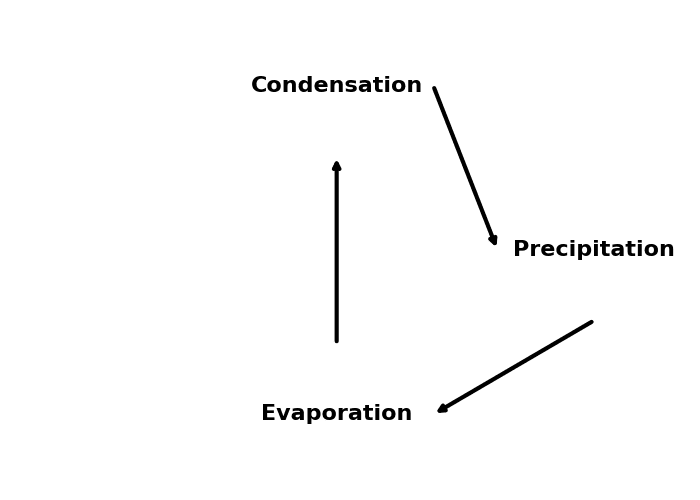
Water moves through stages: evaporation, clouds form, rain falls.
Example: puddles drying after rain.
⚠ Common Mistake: Thinking the cycle has an end.
⏱ In 10 seconds: What step forms clouds?
Climate or Weather – What’s the difference?
📆 long-term vs daily
Weather = day-to-day conditions;
Climate = long-term pattern.
Example: today is rainy (weather), the region is dry (climate).
⚠ Common Mistake: Using weather to judge climate.
⏱ In 10 seconds: Which changes faster?
Renewable – What can be replaced?
🌞 sunlight, wind, water
Renewable resources can be replaced naturally.
Example: solar energy.
⚠ Common Mistake: Thinking renewable = unlimited always.
⏱ In 10 seconds: Name one renewable resource.
Nonrenewable – What runs out?
⛽ oil, coal, gas
Nonrenewable resources take millions of years to form.
Example: fossil fuels.
⚠ Common Mistake: Thinking these can be “regrown.”
⏱ In 10 seconds: Name one nonrenewable resource.
Solar System – What does it include?
🌞 Sun + planets
The solar system includes the sun, eight planets, moons, and other objects.
Example: Earth, Mars, Jupiter.
⚠ Common Mistake: Thinking the sun orbits Earth.
⏱ In 10 seconds: What is at the center?